The Costa Rica fishing license, explained
What it costs, who needs one, and how to have it done before you land
Yes, you need one. Everyone aboard a sport fishing boat in Costa Rica must carry their own INCOPESCA permit, and an 8-day license costs $16.95.
That is the whole answer, and it is worth stating plainly because the internet is unusually bad on this subject. Search it and you will find a heavily upvoted forum thread insisting no such license exists, alongside operator pages quoting four different prices for the same document. Everything below comes from INCOPESCA's own application portal and from the text of the law, checked on 2 September 2026.
What a Costa Rica fishing license costs
The official rates from INCOPESCA's application portal. Tax is included, and the same prices apply to Costa Ricans and foreigners alike.
| License | Valid for | Price | Who it is for |
|---|---|---|---|
| Fishing from a boat | 8 days | $16.95 | Nearly every visitor booking a charter. This is the one you want. |
| Fishing from a boat | 30 days | $28.25 | Longer stays, or two separate charters a few weeks apart. |
| Fishing from a boat | 1 year | $56.50 | Residents, second-home owners and anyone fishing here repeatedly. |
| Underwater fishing | 1 year | $56.50 | Spearfishing. A separate category with its own card. |
| Shore or kayak fishing | 1 year | ₡6,215 | Fishing from the beach, a dock or a non-motorized boat. Roughly $12. |
Prices are per person, not per boat, and were verified against the INCOPESCA portal on 2 September 2026. The boat licenses are priced in US dollars; the shore license is priced in colones.
Who needs one
Costa Rica's Fishing and Aquaculture Law 8436, article 75, requires every person aboard a sport fishing boat to carry a permit issued by INCOPESCA, the national fisheries institute. Three things follow from that wording, and they are the three that catch people out:
- It is per person, not per boat. The captain's paperwork covers the vessel. It does not cover you.
- It applies to everyone aboard. Residents and visitors, and on a strict reading, people who came along for the ride rather than to fish.
- Shore fishing is not exempt. There is a cheaper license for it, not an absence of one. Fishing inside national parks and marine reserves is prohibited either way.
On age, INCOPESCA's position is that under-16s are not permitted to sport fish from a boat, so the boat license is written for adults. Anyone fishing from shore or a kayak needs the shore license whatever their age. If you are traveling with kids who want to fish, raise it with your operator when you book rather than on the dock.
How to buy one
Online, before you travel
This is the easy path and the one we recommend. INCOPESCA runs an English-language application form at incopesca.go.cr. You add each angler, enter their details, choose the license type and pay. Have this ready before you start:
- The start date you want the license to run from. An 8-day license from the wrong date is an 8-day license you cannot use, so set it to your arrival rather than the day you fill the form in.
- First and last name, exactly as they appear on the passport.
- Passport or ID number.
- Email address, which is where the permit arrives.
- Country of residence.
Save a copy to your phone and keep a photo of your passport with it. The Coast Guard does check, and a permit you cannot produce is the same as no permit.
In person, once you are here
INCOPESCA has regional offices, including one in Quepos on (506) 2630-0624 and the Puntarenas headquarters on (506) 2630-0600. In Quepos the office is at Marina Pez Vela, which is also where the charter boats leave from, so buying it the morning of your trip is genuinely workable. Give yourself a little margin rather than arriving fifteen minutes before departure. Every minute spent at a counter is a minute not spent fishing.
The rules worth knowing before you go
The license is the paperwork. These are the rules it commits you to, and the first one surprises a lot of visiting anglers:
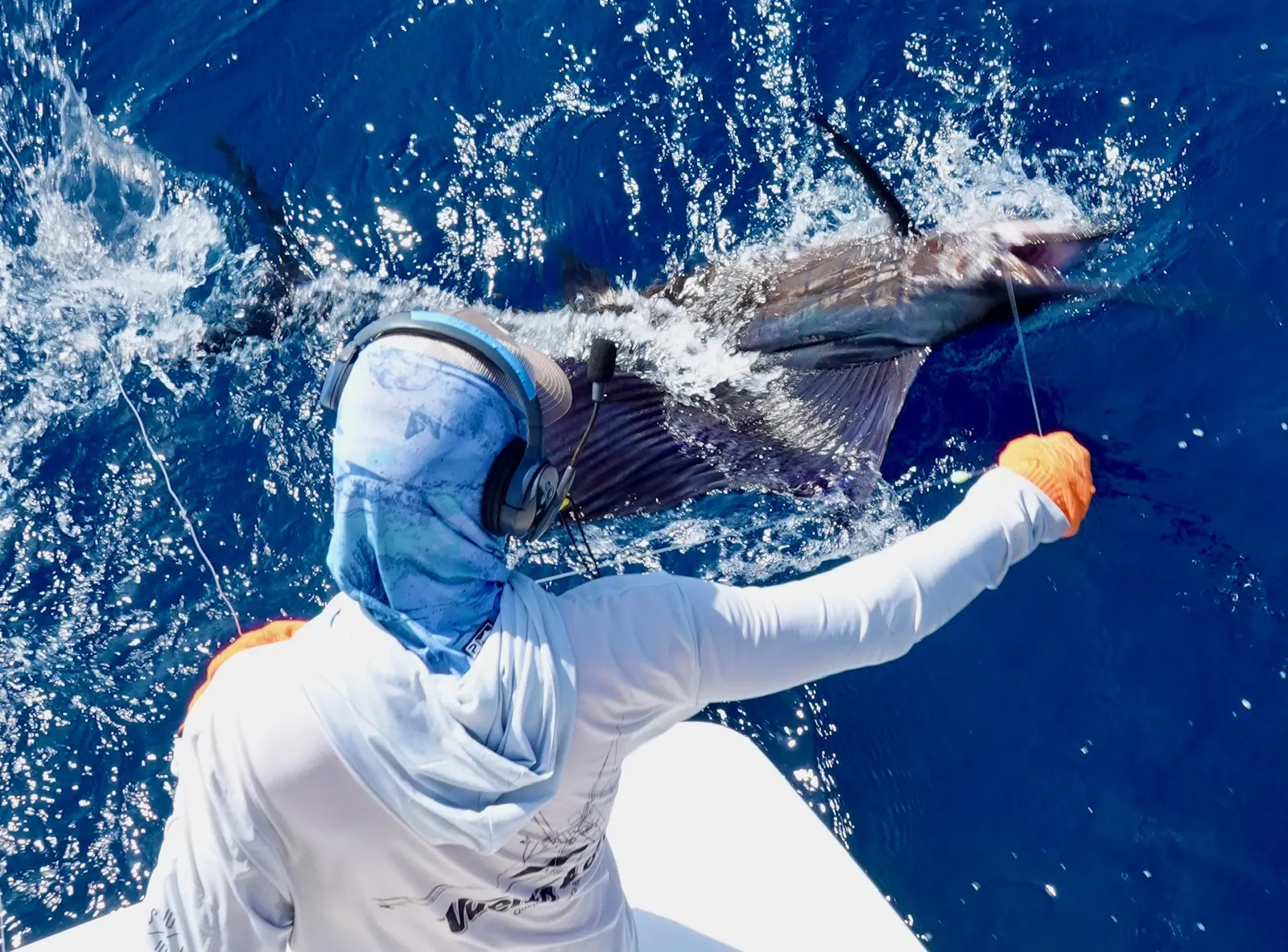
- Billfish are catch and release, by law. Costa Rica banned the killing and commercial export of sailfish and marlin in 2008, one of the first countries in the world to do it. Sailfish, blue marlin, black marlin and striped marlin must be released alive, and should stay in the water while you take the photo. Law 8436 article 76 also names tarpon, and roosterfish were added by INCOPESCA board agreement in 2014.
- There is a landing limit. FECOP, the country's sportfishing advocacy organization, puts it at five fish landed per trip regardless of how many anglers are aboard.
- Protected water is off limits. No fishing inside national parks or marine reserves. On this coast that matters, because Manuel Antonio National Park has a marine section and it starts closer to the fishing grounds than people expect.
None of this is a hardship. Release fishing is the reason the billfishery off this coast is still worth traveling for, and the boats that have fished here longest are the ones most careful about it.
If you are fishing out of Quepos
We run charters from Marina Pez Vela, so this is the version we give our own guests.
We do not buy the license for you, and you should be a little suspicious of anyone who offers to. The application asks for your passport number and personal details. Handing that to a third party to key into a government form is a worse idea than spending four minutes on it yourself, and if the details are wrong it is your day that gets interrupted, not theirs.
So: buy the 8-day license online before you fly, dated to your arrival. If you did not get to it, the INCOPESCA counter is at the same marina your boat leaves from, and the morning of works. Budget $16.95 per angler on top of your charter, alongside the 13% IVA that is added to the charter itself. Those are the only two numbers that are not already in our published rates.
Everything else, the rods and reels, the tackle, the licensed captain and the bilingual crew, is included. The license is genuinely the one thing we cannot hand you.
Costa Rica fishing license questions
Do tourists need a fishing license in Costa Rica?
Yes. Costa Rica's Fishing and Aquaculture Law 8436, article 75, requires everyone aboard a sport fishing boat to carry a permit issued by INCOPESCA. It applies to residents and visitors equally, and it is per person rather than per boat. Your captain's paperwork does not cover you.
How much is a fishing license in Costa Rica?
Straight from INCOPESCA's own portal: $16.95 for 8 days from a boat, $28.25 for 30 days, and $56.50 for a year. A year of spearfishing is also $56.50. A year of fishing from shore or a kayak is 6,215 colones, roughly $12. Those prices include tax. Most visitors on a charter want the 8-day license.
Can I get a Costa Rica fishing license online?
Yes. INCOPESCA runs an English-language application at incopesca.go.cr. You enter your start date, name, passport number, email and country, then pay. Do it before you travel and the whole thing takes a few minutes.
Do I need a license to fish from shore in Costa Rica?
Yes, and this is where most of the bad information online goes wrong. INCOPESCA sells a separate shore and kayak license at 6,215 colones for a full year. It is a different product from the boat license and much cheaper, but it is not nothing, and fishing inside national parks and marine reserves is prohibited regardless.
Is there an age requirement for a Costa Rica fishing license?
INCOPESCA's position is that under-16s are not permitted to sport fish from a boat, so the boat license is written for adults. Anyone fishing from shore or a kayak needs the shore license regardless of age. If you are bringing kids who want to fish, ask your operator before you book rather than at the dock.
Does my charter include the fishing license?
Almost never, and you should ask rather than assume. The application asks for your passport number and personal details, so most operators, including us, have you buy your own. Budget it as a separate line on top of the charter price.
Can I keep the fish I catch in Costa Rica?
Some of them. Billfish are catch and release only: sailfish, blue marlin, black marlin and striped marlin must be released alive and should stay in the water for photos. Roosterfish and tarpon carry the same protection. Mahi, tuna and snapper can be kept, and FECOP puts the limit at five fish landed per trip regardless of how many anglers are aboard.